
USP <81> Antibiotics Microbial Assay Services
We offer USP <81> Antimicrobial Potency testing to support pharmaceutical development, quality control, and release testing of antibiotic substances and formulations. Our laboratory performs validated microbiological assays using both the Cylinder-Plate (agar diffusion) method and the Turbidimetric method, depending on compound characteristics and analytical requirements.
Cylinder-Plate Method (Agar Diffusion Assay)
The USP 81 Antimicrobial Assay Cylinder-Plate method determines antimicrobial potency based on the ability of an antibiotic to inhibit microbial growth in a solid agar medium. Test samples and reference standards are applied to wells or cylinders placed on inoculated agar plates. Following incubation, zones of inhibition are measured and compared against standards to quantify potency.
This method is well-established and widely accepted for antibiotics that diffuse effectively through agar. It is particularly useful for stability testing, release testing, and comparative potency studies. The approach provides robust, visually interpretable results and is suitable for many compendial applications.
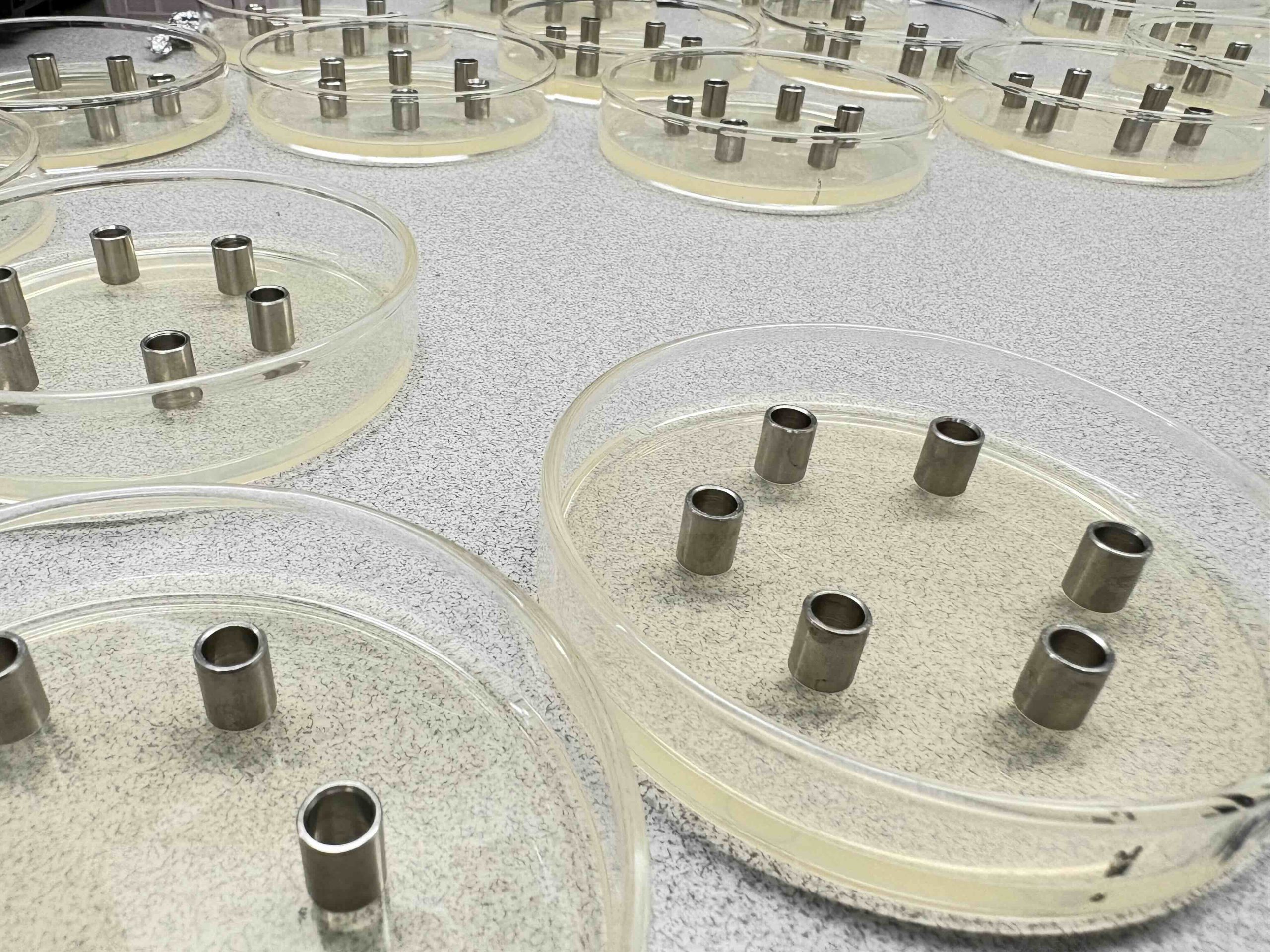
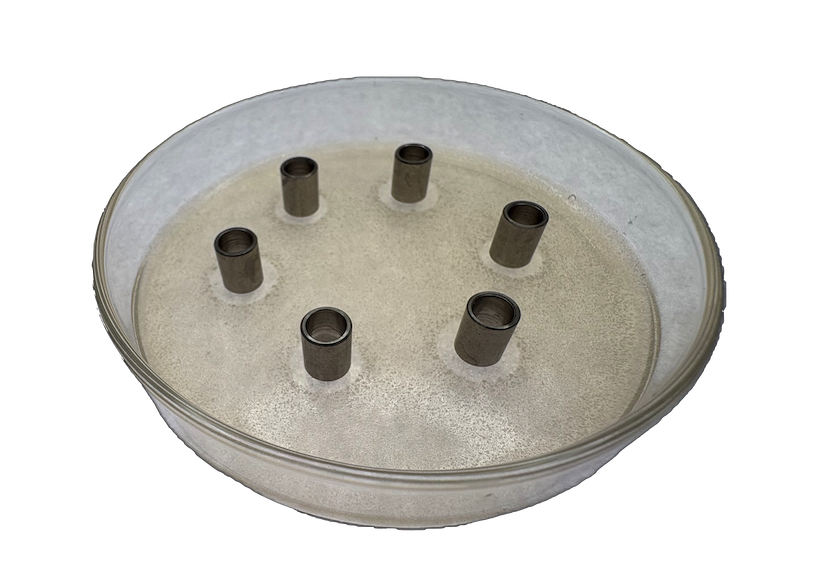
Sample Testing Report for a Cylinder plate USP <81> Antibiotics-Microbial Assay
Turbidimetric Method
The Turbidimetric method evaluates antimicrobial activity by measuring inhibition of microbial growth in a liquid medium. Changes in turbidity (optical density) are monitored over time and compared between test samples and reference standards.
This method is highly sensitive and well-suited for compounds that do not diffuse efficiently in agar. It offers improved precision, faster turnaround time, and is readily adaptable to semi-automated or high-throughput workflows. The turbidimetric assay is especially useful for potency determination in complex matrices or when higher analytical sensitivity is required.